Draw-out breakers fail more often but return to service faster
Survey data show draw-out low-voltage breakers with a higher failure rate and a much shorter repair time than fixed breakers. RokBench keeps both, and now treats ACB and VCB as draw-out by default.
Why we looked again
An external review of the RokBench failure catalog suggested giving draw-out and fixed breakers the same failure rate, because the what-if option "make this breaker draw-out" made results worse. Engine 0.40.0 followed that suggestion. On reflection it was the wrong fix, and 0.41.0 reverted it.
What the survey says
The U.S. Army survey of power equipment reliability lists low-voltage breakers by construction. Draw-out (metal-clad) breakers fail far more often per breaker-year, but they are back in service in a fraction of the time.
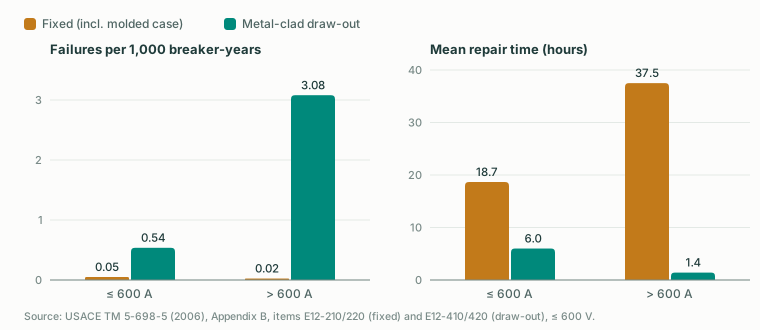
| Breaker, ≤ 600 V | Failures per year | Mean repair time |
|---|---|---|
| Fixed, ≤ 600 A (E12-210) | 0.00005 | 18.7 h |
| Fixed, > 600 A (E12-220) | 0.00002 | 37.5 h |
| Draw-out, ≤ 600 A (E12-410) | 0.000536 | 6.0 h |
| Draw-out, > 600 A (E12-420) | 0.00308 | 1.4 h |
Why that makes physical sense
- More parts that can fail. A draw-out breaker adds primary disconnect fingers, a racking mechanism and secondary control disconnects. Overheated finger clusters and racking faults are familiar field failures that a bolted breaker does not have.
- Faster return to service. A failed draw-out breaker is racked out and replaced with a spare in the same cubicle. A fixed breaker has to be unbolted with the bus de-energized.
- Reporting. Large draw-out breakers are maintained and tested on a schedule, so their failures are found and recorded; failures of small molded-case breakers are often replaced without a report. Part of the gap is likely reporting, and the fixed > 600 A figure (once in 50,000 breaker-years) rests on a small population.
Multiplying the two gives expected repair hours per breaker-year:
So on raw survey numbers a draw-out breaker is not "more reliable". Its advantages are maintainability — it can be racked out for maintenance and swapped quickly — and containment of an internal fault to its own compartment.
What RokBench does now
- A draw-out breaker uses the survey's draw-out entry for both failure rate and repair time. The 0.40.0 change had paired the low fixed failure rate with the long fixed repair time, which erased the draw-out advantage.
- ACB and VCB count as draw-out by default — almost all of them are draw-out in current practice — and are drawn with the draw-out symbol on the one-line. MCCB, ICCB and SF₆ breakers count as draw-out only when the inspector option is set.
- Draw-out also limits the damage of an internal breaker fault to the breaker itself.
Still open: a breaker internal fault is restored by replacement with a fixed return-to-service time, so the quick swap of a draw-out spare is not yet credited for that event.
References
- U.S. Army Corps of Engineers, TM 5-698-5: Survey of Reliability and Availability Information for Power Distribution, Power Generation, and HVAC Components for Commercial, Industrial, and Utility Installations, 2006, Appendix B. WBDG
- IEEE Std 493-2007, Recommended Practice for the Design of Reliable Industrial and Commercial Power Systems (Gold Book) — background on equipment reliability surveys.