Loading & Headroom
Connected load summed up the system and compared with each element's rating. This is aggregation, not a load flow.
1. What this check does
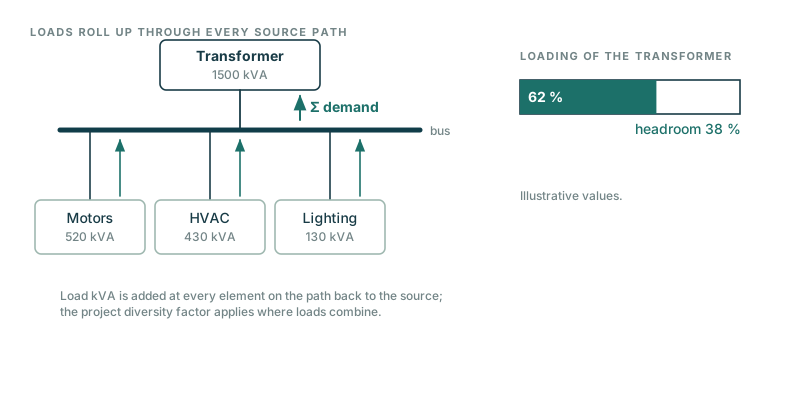
RokBench follows the normally closed, energized paths from every load back to its sources and adds the load kVA at each element on the way. Where two or more loads combine, the project diversity factor is applied. The demand at each rated element is compared with its rating to give percent loading and headroom. Every cable in the model can then be checked with the current flowing through it.
2. Inputs used
- Loads: kW with power factor, or kVA. Motors: HP or kW output, efficiency and power factor.
- Ratings: kVA for transformers, generators and UPS; continuous amperes for buses, switchgear, panels, MCCs, PDUs, RPPs and transfer switches; trip amperes for breakers.
- Voltage from the equipment rating, or inherited from the nearest upstream element.
- Project diversity factor (optional).
3. Formulas and assumptions
- Motor efficiency left blank defaults to the US federal minimum for a 4-pole enclosed motor of that rating (10 CFR 431.25, 2016 levels; fire pumps use the fire pump motor table), with ratings between table values rounded as the regulation specifies.
- Normal configuration only: normally open ties and standby sources carry no load.
- Loads split equally between paths when fed by more than one closed path. After losing one path, the other carries the whole load; use the scenario tools to explore that.
- Ampere ratings are converted to kVA as three-phase unless the equipment is marked single-phase (Phases = 1), for example a 120/240 V panel, which then uses V × A.
- Missing load data makes the totals above it lower bounds; the table marks them.
- A high-loading warning appears before the rating is reached; the threshold is part of the engine.
4. What is NOT checked
- Voltage and power flow: no load flow solution is computed.
- Motor starting kVA, harmonics and unbalance.
- Continuous-load factors on equipment ratings and ambient derating.
- Short-circuit duty.
5. Reference standards
Pointers only; consult the edition adopted by your authority having jurisdiction.
- NEC 2023 Article 220 — branch-circuit, feeder and service load calculations (context)
- NEC 2023 450.3 — transformer overcurrent protection (context)
6. Validation cases
No worked example with a published answer is registered for this page yet. Have one we should add? Use the Feedback link. All cases: Validation.
7. Known issues and changes
See the Engineering Notes. Try the tool: Workbench (Loading tab).