Methods / Full-Load Current
How RokBench checks this
Full-Load Current
Converting power to current, and why the result is not the motor table value.
1. What this check does
Converts a load given in kW, HP or kVA into line current for a single- or three-phase system.
2. Inputs used
- Load value and unit, system voltage (line-to-line for three-phase), number of phases.
- Power factor (kW, HP) and efficiency (optional for HP — see below).
3. Formulas and assumptions
Three-phase
S in VA, V line-to-line.
Single-phase
HP
Shaft output. kW without η is treated as electrical input (η = 1).
Symbols
| Apparent power | VA | |
| Real power | W | |
| Voltage, line-to-line for three-phase | V | |
| Power factor | ||
| Efficiency (motor shaft output to electrical input) | ||
| Full-load current | A |
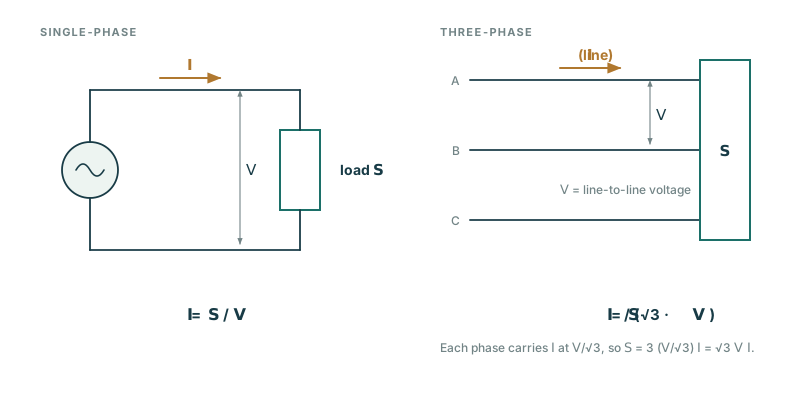
- Voltage is the nominal system voltage you enter. Operating at reduced voltage increases current for the same power.
- Balanced three-phase load; no harmonic content.
- HP with efficiency left blank uses the US federal minimum for a 4-pole enclosed motor of that rating (10 CFR 431.25, 2016 levels); the result says so.
4. What is NOT checked
- This is not the NEC motor full-load current. Conductors and most protection for motors are sized from the NEC table values, not from nameplate or calculated current.
- Motor service factor, starting current and unbalanced loads.
5. Reference standards
- NEC 2023 430.6(A)(1), Tables 430.248 and 430.250 — motor full-load current for conductor sizing
6. Validation cases
Hand-calculated cases run on every change. See Validation.
7. Known issues and changes
See the Engineering Notes. Try the tool: Full-Load Current.